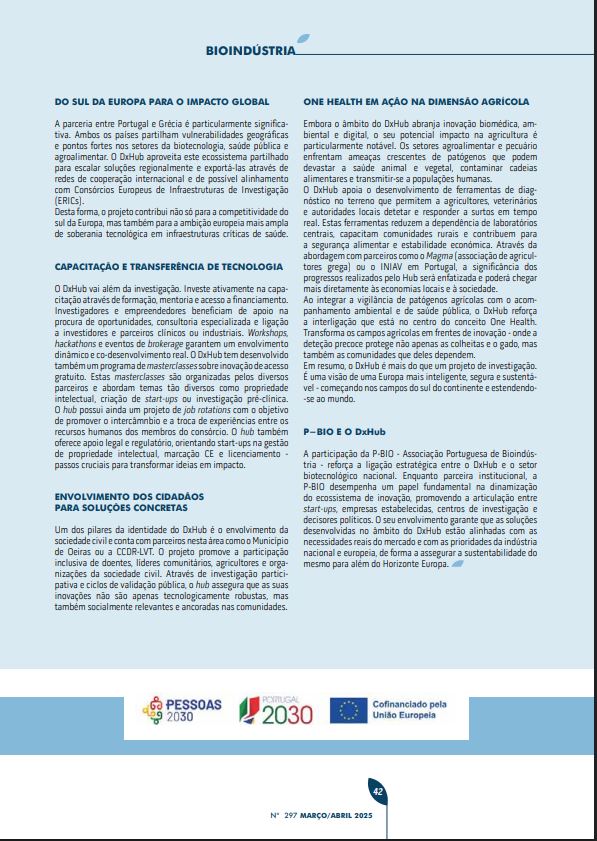
An article was published in Revista do Agricultor, issue N.º 297, under the theme “Innovation in One Health Diagnostics from Southern Europe” , presenting the DxHub. “Revista do Agricultor” (The Farmer’s Magazine) is a Portuguese publication focused on agriculture and rural life, serving as a platform for disseminating specialized information within the agricultural sector. Read the article, translated, here:
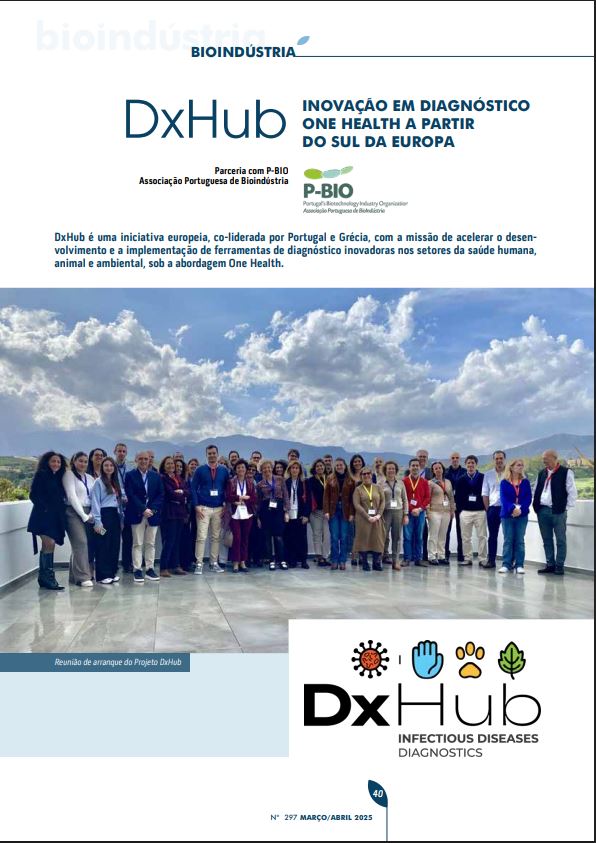
From pandemics to antimicrobial resistance, including zoonoses (diseases that can be transmitted between animals and humans) and plant diseases linked to climate change and foodborne pathogens, the urgency for rapid and accessible diagnostic solutions has never been more evident. At the center of this transformative landscape, DxHub emerges as a unique European initiative, co-led by Portugal and Greece and funded by the Horizon Europe programme, within the framework of collaborative research and innovation projects.
Its mission is to accelerate the development and implementation of innovative diagnostic tools across the human, animal, and environmental health sectors, following the One Health approach. DxHub is not just another research project. It is a cross-border innovation hub, rooted in the real needs of Southern Europe but designed with global impact in mind. Its strategic ambition is to foster agile diagnostic solutions that can be developed, validated, and deployed quickly—particularly in regions where early disease detection can mean the difference between control and crisis.
WHAT SETS DxHub APART?
DxHub is based on a collaborative model that actively involves academia, industry, public authorities, and civil society—the so-called Quadruple Helix model.
Its business model combines public health priorities with entrepreneurial dynamics, offering structured pathways for knowledge sharing, technology transfer, and the commercialization of innovative solutions.
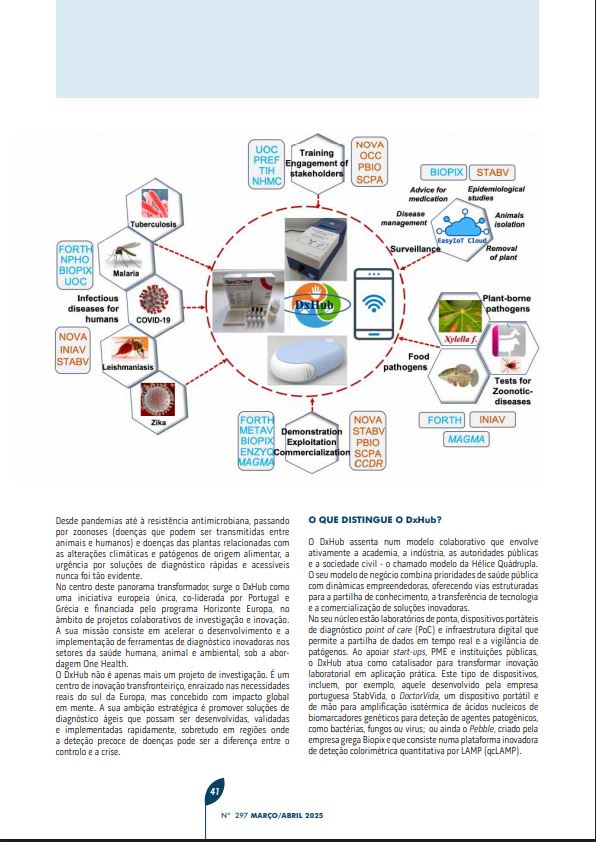
At its core are state-of-the-art laboratories, portable point-of-care (PoC) diagnostic devices, and a digital infrastructure that enables real-time data sharing and pathogen surveillance. By supporting start-ups, SMEs, and public institutions, DxHub acts as a catalyst for turning lab innovation into real-world application.
Examples of such devices include the DoctorVida, developed by Portuguese company StabVida—a handheld, portable device for isothermal amplification of nucleic acids of genetic biomarkers to detect pathogenic agents such as bacteria, fungi, or viruses; and the Pebble, developed by the Greek company Biopix—a groundbreaking platform for quantitative colorimetric detection using LAMP (qcLAMP) technology.
FROM SOUTHERN EUROPE TO GLOBAL IMPACT
The partnership between Portugal and Greece is particularly significant. Both countries share geographical vulnerabilities and strengths in the biotechnology, public health, and agri-food sectors. DxHub leverages this shared ecosystem to scale solutions regionally and export them through international cooperation networks and potential alignment with European Research Infrastructure Consortia (ERICs).
In doing so, the project contributes not only to the competitiveness of Southern Europe but also to the broader European ambition of achieving technological sovereignty in critical health infrastructures.
CAPACITY BUILDING AND TECHNOLOGY TRANSFER
DxHub goes beyond research. It actively invests in capacity building through training, mentoring, and access to funding. Researchers and entrepreneurs benefit from support in opportunity scouting, expert consulting, and connections with investors and clinical or industrial partners.
Workshops, hackathons, and brokerage events ensure dynamic engagement and real co-development. DxHub has also developed a free-access masterclass programme on innovation. These masterclasses are hosted by various partners and cover topics such as intellectual property, start-up creation, and pre-clinical research.
The hub also runs a job rotation project aimed at promoting exchange and sharing of experiences among consortium members’ human resources. In addition, it provides legal and regulatory support, guiding start-ups in managing intellectual property, CE marking, and licensing—crucial steps in turning ideas into impact.
CITIZEN ENGAGEMENT FOR CONCRETE SOLUTIONS
One of the pillars of DxHub’s identity is the involvement of civil society, with partners in this area such as the Municipality of Oeiras and CCDR-LVT. The project fosters inclusive participation from patients, community leaders, farmers, and civil society organisations.
Through participatory research and public validation cycles, the hub ensures that its innovations are not only technologically sound but also socially relevant and grounded in the communities it serves.
ONE HEALTH IN ACTION: THE AGRICULTURAL DIMENSION
Although DxHub’s scope spans biomedical, environmental, and digital innovation, its potential impact on agriculture is particularly significant. The agri-food and livestock sectors face growing threats from pathogens that can devastate animal and plant health, contaminate food chains, and be transmitted to human populations.
DxHub supports the development of field diagnostic tools that enable farmers, veterinarians, and local authorities to detect and respond to outbreaks in real time. These tools reduce reliance on central laboratories, empower rural communities, and contribute to food security and economic stability.
Through collaboration with partners such as Magma (a Greek farmers’ association) and INIAV in Portugal, the relevance of the Hub’s progress is amplified and can more directly reach local economies and society.
By integrating surveillance of agricultural pathogens with environmental and public health monitoring, DxHub strengthens the interconnectedness at the heart of the One Health concept.
It transforms agricultural fields into innovation frontlines—where early detection protects not only crops and livestock but also the communities that rely on them.
In short, DxHub is more than a research project. It is a vision for a smarter, safer, and more sustainable Europe—starting in the fields of the continent’s south and extending to the world.
P-BIO AND DxHub
The involvement of P-BIO – Portuguese BioIndustry Association – reinforces the strategic connection between DxHub and the national biotech sector. As an institutional partner, P-BIO plays a key role in energizing the innovation ecosystem by promoting collaboration among start-ups, established companies, research centers, and policymakers.
Its engagement ensures that the solutions developed within DxHub are aligned with real market needs and the priorities of both the national and European industries, securing the project’s sustainability beyond Horizon Europe.